 Add to Chrome
 Add to Firefox
 Add to Edge
VitaBench 2.0: Evaluating Personalized and Proactive Agents in Long-Term User Interactions
May 26, 2026
Large language models (LLMs) have evolved into interactive agents that collaborate with users in real-world tasks. Effective collaboration in such settings increasingly depends on understanding the user beyond what is explicitly stated, as user intent is often reflected in fragmented daily interactions and requires both personalized modeling and proactive interaction. However, existing agent benchmarks primarily evaluate reasoning and tool use, largely overlooking the challenges of inferring and leveraging user preferences in realistic scenarios. To address this gap, we introduce VitaBench 2.0, a benchmark for evaluating personalized and proactive agent behavior in long-term user interactions. In VitaBench 2.0, tasks are organized as temporally ordered sequences for individual users, where preferences are embedded in fragmented and heterogeneous interactions. Successful completion of tasks requires the agent to continuously extract, utilize, and update user preferences from these interactions. We further evaluate proactiveness through tasks that require agents to recognize missing information and actively acquire it from users or environments before making decisions. To support systematic analysis, we provide an extensible memory interface that enables controlled comparison across different memory architectures. We benchmark a diverse set of frontier proprietary and open-source LLMs. Results show that real-world personalization remains highly challenging even for state-of-the-art models, revealing a substantial gap between current capabilities and practical requirements. Extensive analysis further reveals the failure modes and capability bottlenecks of current agents in real-world personalized decision-making, providing insights for future model improvements.

WildRoadBench: A Wild Aerial Road-Damage Grounding Benchmark for Vision-Language Models and Autonomous Agents
May 19, 2026We introduce WildRoadBench, a wild aerial road-damage grounding benchmark that couples direct visual grounding by vision-language models with autonomous research-and-engineering by LLM-driven agents on a single professionally annotated UAV corpus. The same image set and the same per-class AP_50 metric are evaluated under two protocols. The VLM Track measures whether a fixed VLM can localise domain-specific damage from one image and one short prompt under a unified prompting, decoding and parsing pipeline. The Agent Track measures whether an autonomous agent, given only a written task brief, a small exploratory slice and a fixed interaction budget, can search the public web, adapt pretrained components, write training and inference code, and submit predictions through a scalar-feedback oracle on a hidden holdout. We benchmark a broad pool of closed-source frontier models and open-source VLMs together with several frontier LLM-driven agents. Both routes remain far from reliable performance in this wild setting: closed-source frontier models lead the VLM leaderboard but still leave more than half of the metric on the table; open-source grounders plateau well below them, and newer generations or reasoning-style variants do not consistently improve grounding; small targets collapse for every open-source model; agents lag the strongest VLM despite richer affordances, and several fail to land a valid submission within the budget. We release the code and data at https://anonymous.4open.science/r/wildroadbench-0607 to support reproducible follow-up research.
Do LLMs and VLMs Share Neurons for Inference? Evidence and Mechanisms of Cross-Modal Transfer
Feb 22, 2026Large vision-language models (LVLMs) have rapidly advanced across various domains, yet they still lag behind strong text-only large language models (LLMs) on tasks that require multi-step inference and compositional decision-making. Motivated by their shared transformer architectures, we investigate whether the two model families rely on common internal computation for such inference. At the neuron level, we uncover a surprisingly large overlap: more than half of the top-activated units during multi-step inference are shared between representative LLMs and LVLMs, revealing a modality-invariant inference subspace. Through causal probing via activation amplification, we further show that these shared neurons encode consistent and interpretable concept-level effects, demonstrating their functional contribution to inference. Building on this insight, we propose Shared Neuron Low-Rank Fusion (SNRF), a parameter-efficient framework that transfers mature inference circuitry from LLMs to LVLMs. SNRF profiles cross-model activations to identify shared neurons, computes a low-rank approximation of inter-model weight differences, and injects these updates selectively within the shared-neuron subspace. This mechanism strengthens multimodal inference performance with minimal parameter changes and requires no large-scale multimodal fine-tuning. Across diverse mathematics and perception benchmarks, SNRF consistently enhances LVLM inference performance while preserving perceptual capabilities. Our results demonstrate that shared neurons form an interpretable bridge between LLMs and LVLMs, enabling low-cost transfer of inference ability into multimodal models. Our code is available at [https://github.com/chenhangcuisg-code/Do-LLMs-VLMs-Share-Neurons](https://github.com/chenhangcuisg-code/Do-LLMs-VLMs-Share-Neurons).
Transport and Merge: Cross-Architecture Merging for Large Language Models
Feb 05, 2026Large language models (LLMs) achieve strong capabilities by scaling model capacity and training data, yet many real-world deployments rely on smaller models trained or adapted from low-resource data. This gap motivates the need for mechanisms to transfer knowledge from large, high-resource models to smaller, low-resource targets. While model merging provides an effective transfer mechanism, most existing approaches assume architecture-compatible models and therefore cannot directly transfer knowledge from large high-resource LLMs to heterogeneous low-resource targets. In this work, we propose a cross-architecture merging framework based on optimal transport (OT) that aligns activations to infer cross-neuron correspondences between heterogeneous models. The resulting transport plans are then used to guide direct weight-space fusion, enabling effective high-resource to low-resource transfer using only a small set of inputs. Extensive experiments across low-resource languages and specialized domains demonstrate consistent improvements over target models.
Reliable and Responsible Foundation Models: A Comprehensive Survey
Feb 04, 2026Foundation models, including Large Language Models (LLMs), Multimodal Large Language Models (MLLMs), Image Generative Models (i.e, Text-to-Image Models and Image-Editing Models), and Video Generative Models, have become essential tools with broad applications across various domains such as law, medicine, education, finance, science, and beyond. As these models see increasing real-world deployment, ensuring their reliability and responsibility has become critical for academia, industry, and government. This survey addresses the reliable and responsible development of foundation models. We explore critical issues, including bias and fairness, security and privacy, uncertainty, explainability, and distribution shift. Our research also covers model limitations, such as hallucinations, as well as methods like alignment and Artificial Intelligence-Generated Content (AIGC) detection. For each area, we review the current state of the field and outline concrete future research directions. Additionally, we discuss the intersections between these areas, highlighting their connections and shared challenges. We hope our survey fosters the development of foundation models that are not only powerful but also ethical, trustworthy, reliable, and socially responsible.
Risky-Bench: Probing Agentic Safety Risks under Real-World Deployment
Feb 03, 2026Large Language Models (LLMs) are increasingly deployed as agents that operate in real-world environments, introducing safety risks beyond linguistic harm. Existing agent safety evaluations rely on risk-oriented tasks tailored to specific agent settings, resulting in limited coverage of safety risk space and failing to assess agent safety behavior during long-horizon, interactive task execution in complex real-world deployments. Moreover, their specialization to particular agent settings limits adaptability across diverse agent configurations. To address these limitations, we propose Risky-Bench, a framework that enables systematic agent safety evaluation grounded in real-world deployment. Risky-Bench organizes evaluation around domain-agnostic safety principles to derive context-aware safety rubrics that delineate safety space, and systematically evaluates safety risks across this space through realistic task execution under varying threat assumptions. When applied to life-assist agent settings, Risky-Bench uncovers substantial safety risks in state-of-the-art agents under realistic execution conditions. Moreover, as a well-structured evaluation pipeline, Risky-Bench is not confined to life-assist scenarios and can be adapted to other deployment settings to construct environment-specific safety evaluations, providing an extensible methodology for agent safety assessment.
Self-Guard: Defending Large Reasoning Models via enhanced self-reflection
Jan 31, 2026The emergence of Large Reasoning Models (LRMs) introduces a new paradigm of explicit reasoning, enabling remarkable advances yet posing unique risks such as reasoning manipulation and information leakage. To mitigate these risks, current alignment strategies predominantly rely on heavy post-training paradigms or external interventions. However, these approaches are often computationally intensive and fail to address the inherent awareness-compliance gap, a critical misalignment where models recognize potential risks yet prioritize following user instructions due to their sycophantic tendencies. To address these limitations, we propose Self-Guard, a lightweight safety defense framework that reinforces safety compliance at the representational level. Self-Guard operates through two principal stages: (1) safety-oriented prompting, which activates the model's latent safety awareness to evoke spontaneous reflection, and (2) safety activation steering, which extracts the resulting directional shift in the hidden state space and amplifies it to ensure that safety compliance prevails over sycophancy during inference. Experiments demonstrate that Self-Guard effectively bridges the awareness-compliance gap, achieving robust safety performance without compromising model utility. Furthermore, Self-Guard exhibits strong generalization across diverse unseen risks and varying model scales, offering a cost-efficient solution for LRM safety alignment.
Lingua-SafetyBench: A Benchmark for Safety Evaluation of Multilingual Vision-Language Models
Jan 30, 2026Robust safety of vision-language large models (VLLMs) under joint multilingual and multimodal inputs remains underexplored. Existing benchmarks are typically multilingual but text-only, or multimodal but monolingual. Recent multilingual multimodal red-teaming efforts render harmful prompts into images, yet rely heavily on typography-style visuals and lack semantically grounded image-text pairs, limiting coverage of realistic cross-modal interactions. We introduce Lingua-SafetyBench, a benchmark of 100,440 harmful image-text pairs across 10 languages, explicitly partitioned into image-dominant and text-dominant subsets to disentangle risk sources. Evaluating 11 open-source VLLMs reveals a consistent asymmetry: image-dominant risks yield higher ASR in high-resource languages, while text-dominant risks are more severe in non-high-resource languages. A controlled study on the Qwen series shows that scaling and version upgrades reduce Attack Success Rate (ASR) overall but disproportionately benefit HRLs, widening the gap between HRLs and Non-HRLs under text-dominant risks. This underscores the necessity of language- and modality-aware safety alignment beyond mere scaling.To facilitate reproducibility and future research, we will publicly release our benchmark, model checkpoints, and source code.The code and dataset will be available at https://github.com/zsxr15/Lingua-SafetyBench.Warning: this paper contains examples with unsafe content.
Improving Alignment in LVLMs with Debiased Self-Judgment
Aug 28, 2025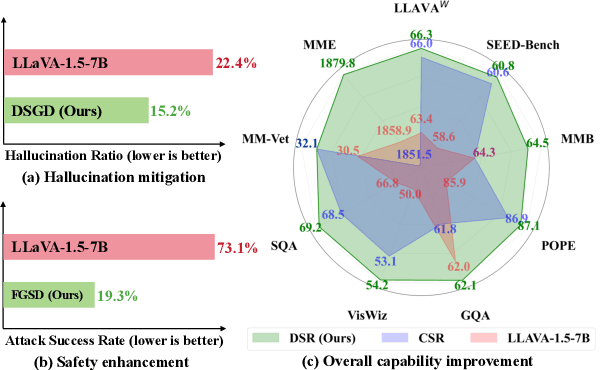
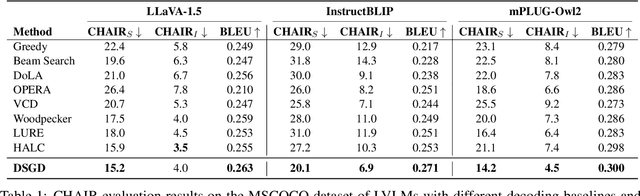
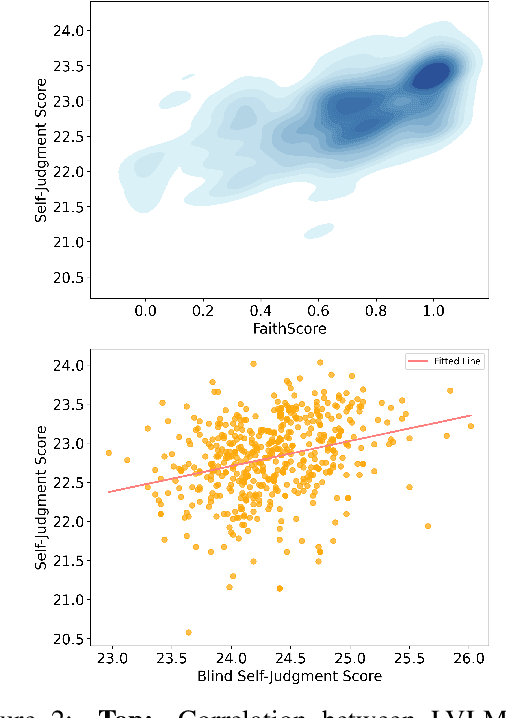
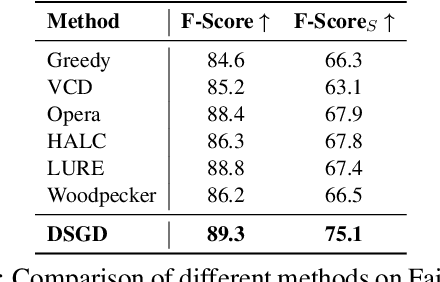
The rapid advancements in Large Language Models (LLMs) and Large Visual-Language Models (LVLMs) have opened up new opportunities for integrating visual and linguistic modalities. However, effectively aligning these modalities remains challenging, often leading to hallucinations--where generated outputs are not grounded in the visual input--and raising safety concerns across various domains. Existing alignment methods, such as instruction tuning and preference tuning, often rely on external datasets, human annotations, or complex post-processing, which limit scalability and increase costs. To address these challenges, we propose a novel approach that generates the debiased self-judgment score, a self-evaluation metric created internally by the model without relying on external resources. This enables the model to autonomously improve alignment. Our method enhances both decoding strategies and preference tuning processes, resulting in reduced hallucinations, enhanced safety, and improved overall capability. Empirical results show that our approach significantly outperforms traditional methods, offering a more effective solution for aligning LVLMs.
VFlowOpt: A Token Pruning Framework for LMMs with Visual Information Flow-Guided Optimization
Aug 07, 2025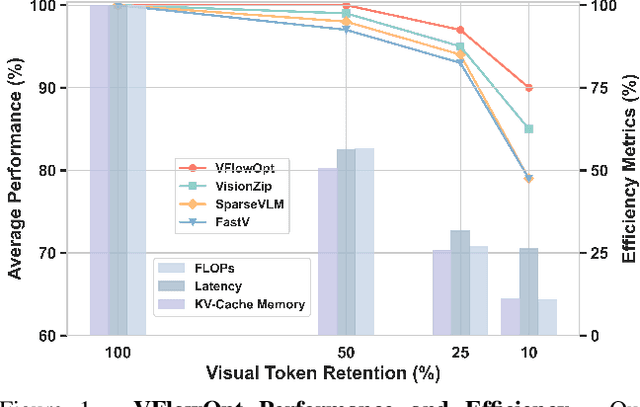

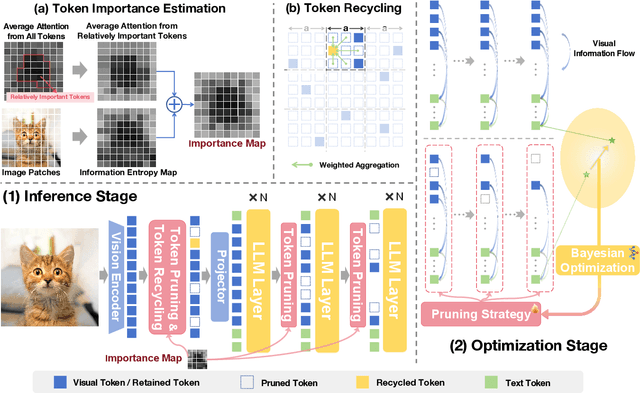
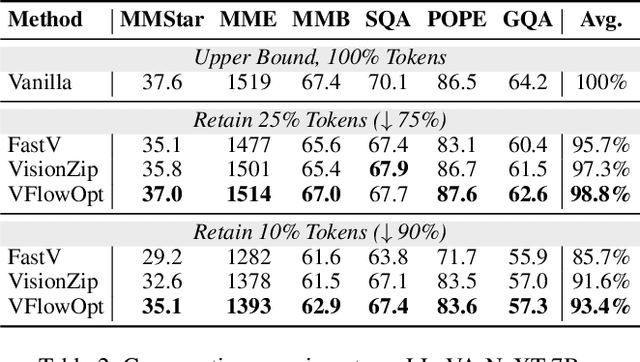
Large Multimodal Models (LMMs) excel in visual-language tasks by leveraging numerous visual tokens for fine-grained visual information, but this token redundancy results in significant computational costs. Previous research aimed at reducing visual tokens during inference typically leverages importance maps derived from attention scores among vision-only tokens or vision-language tokens to prune tokens across one or multiple pruning stages. Despite this progress, pruning frameworks and strategies remain simplistic and insufficiently explored, often resulting in substantial performance degradation. In this paper, we propose VFlowOpt, a token pruning framework that introduces an importance map derivation process and a progressive pruning module with a recycling mechanism. The hyperparameters of its pruning strategy are further optimized by a visual information flow-guided method. Specifically, we compute an importance map for image tokens based on their attention-derived context relevance and patch-level information entropy. We then decide which tokens to retain or prune and aggregate the pruned ones as recycled tokens to avoid potential information loss. Finally, we apply a visual information flow-guided method that regards the last token in the LMM as the most representative signal of text-visual interactions. This method minimizes the discrepancy between token representations in LMMs with and without pruning, thereby enabling superior pruning strategies tailored to different LMMs. Experiments demonstrate that VFlowOpt can prune 90% of visual tokens while maintaining comparable performance, leading to an 89% reduction in KV-Cache memory and 3.8 times faster inference.